

Seoul Marathon 2026 Race Report
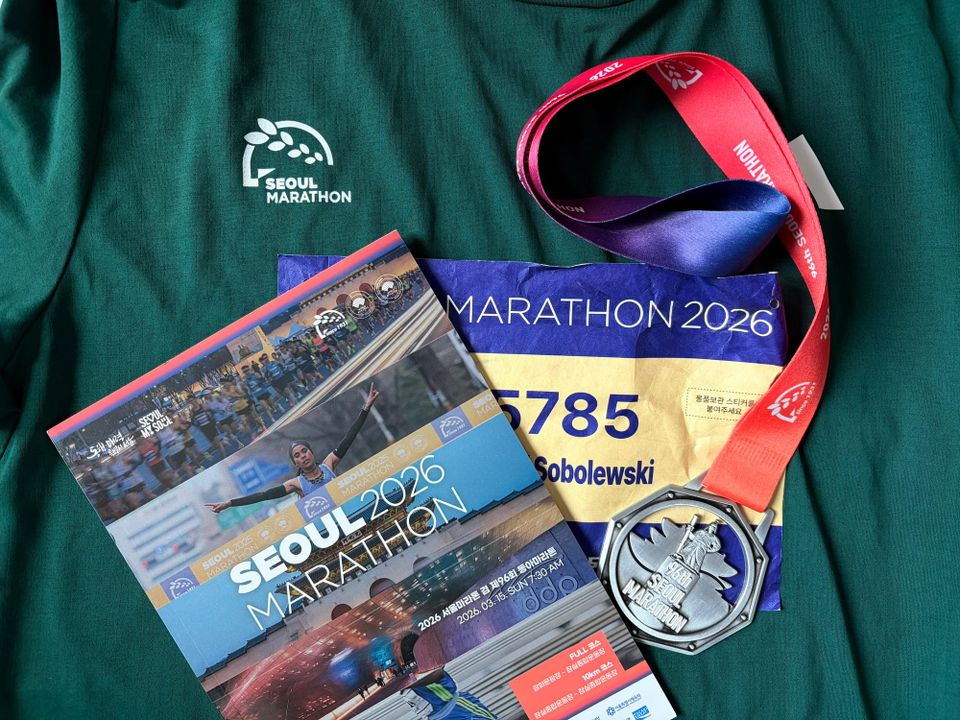
This entire run racing season has been, for the most part, challenging and with some unexpected turns. Like running down multiple flights of stairs during the Pink Run. Spending one third of the race in tunnels during the Streetathon. Getting completely destroyed by the weather in the Singapore Half. Every race had to throw in something unexpected to throw me off and obfuscate the progress I’ve been making.
But then, Hong Kong Marathon gave me hope. And for the race in Seoul, finally the conditions were good. Favorable weather (4-7 degrees, overcast, light drizzle in the second half) and a course that was mostly flat (and net down-hill). No hills, no heat, no stairs, no illness or injury. Could not ask for more personal-best-friendly circumstances. Even my run coach encouraged me to go for sub-4 for this race. Seriously?
I could have asked more of myself, though. My training block leading up to Seoul was far from optimal. In the 8 weeks since the HK race I had not done any proper long run — I did not run past 15 km at any point! And I had a one-week break for a snowboarding trip. That got me worried — was I wasting perfect racing conditions by not training hard enough?
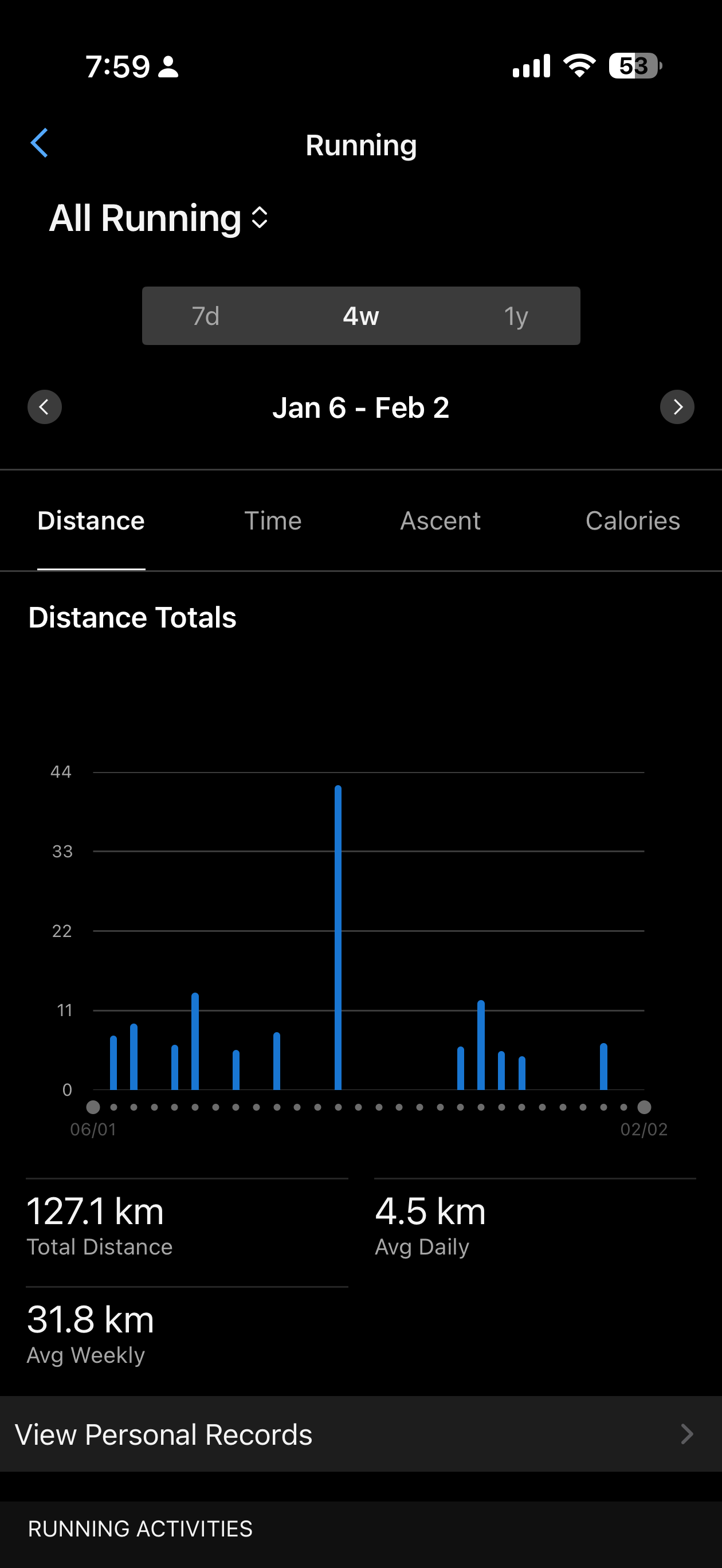
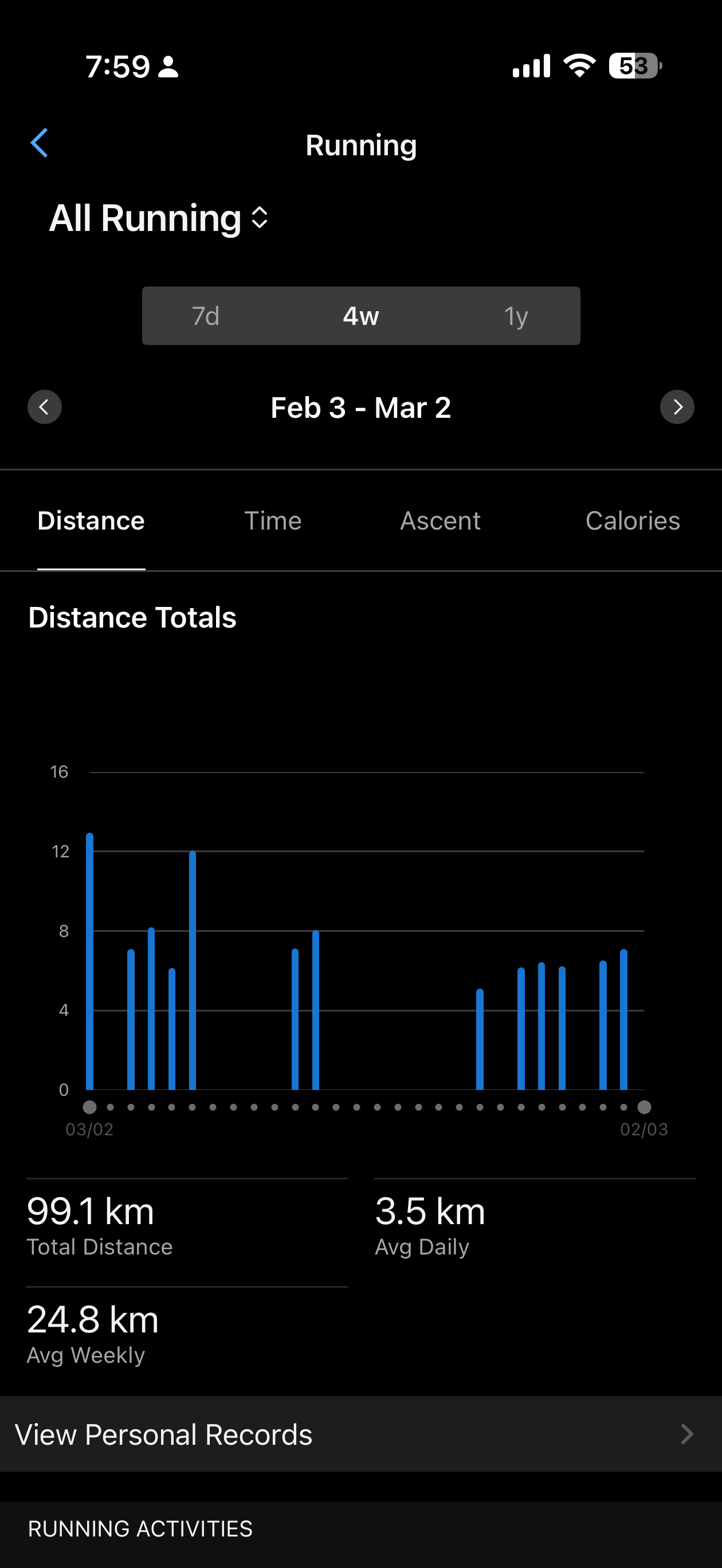
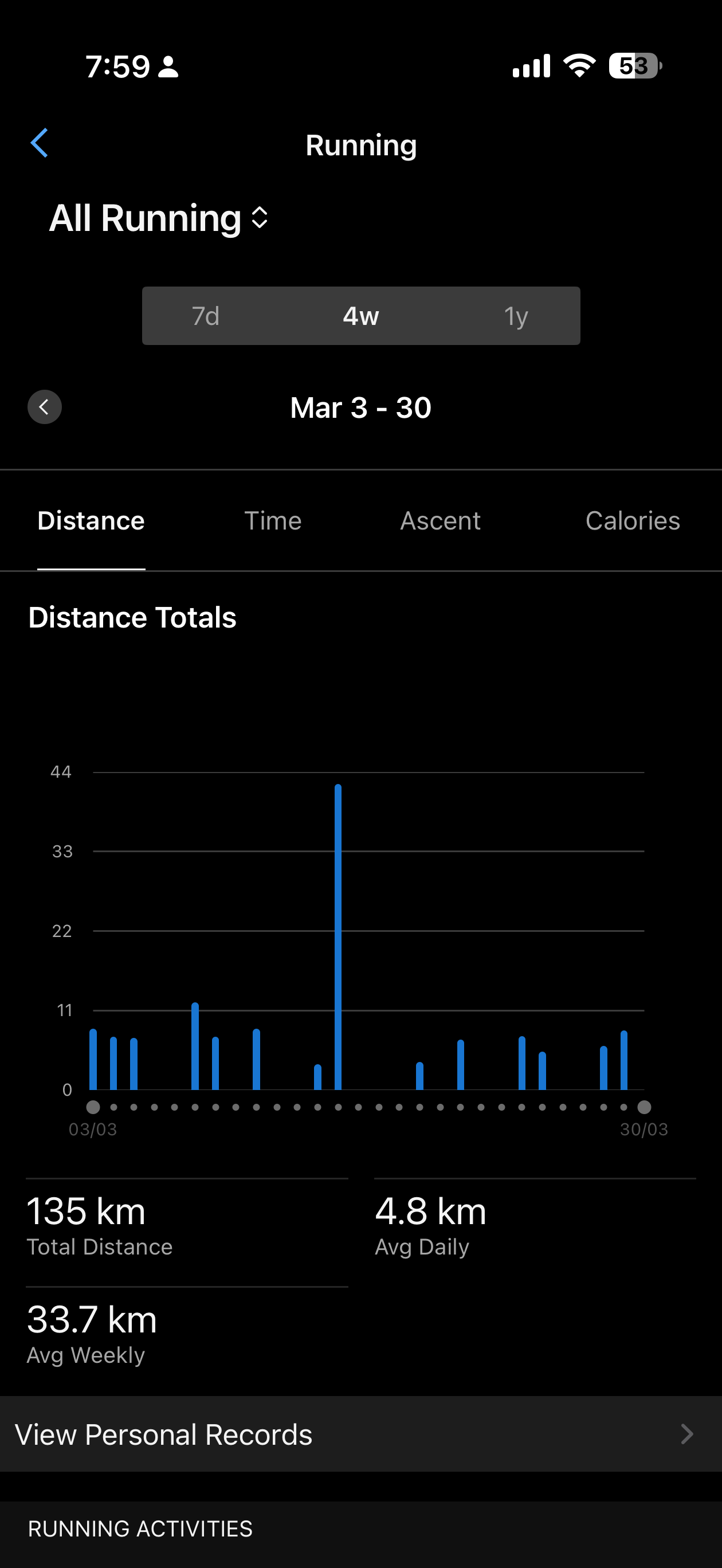
Bad bad not good training block between two marathons
Self-doubt was creeping in, big time. Here it is, your final big race of the season. You’ve got everything going in your favor — and you’re wasting it. You’re not doing enough. And if you can’t perform your best in those conditions, you’re going to be a failure. So maybe it’s safer not to even try? To be honest, I wasn’t sure if I wanted to go. I booked the flights only 10 days ahead of the race (with having the race entry confirmed since September of last year…)
Eventually we got to Seoul (my wife accompanied me — I’m extremely grateful!) My priority was to control the remaining controllables. Our hotel was less than 400 meters from the starting line — stress-free race morning secured. Race kit tested in a shakeout run the day before the event — this was key, given my unfamiliarity with running in cold weather. And for the race day — full kit laid out, breakfast onigiri ready, alarms set (with enough time for all morning stuff and getting to Gwanghwamun Square with enough buffer for a stretch/warmup).
My race kit:
- ASICS Megablast running shoes
- ASICS running socks
- T8 running briefs
- ASICS running shorts
- Flipbelt running belt
- Garmin Forerunner 970 watch and HRM 600 chest heart rate monitor
- Seoul Marathon t-shirt
- Light Uniqlo running jacket, thin Montbell gloves, and a plastic rain poncho — layers ready to shed should it get warmer
- Neck buff
- Some cheap UVex running sunglasses
- On running cap
- 2× Maurten Gel 100 Caf 100, 6x Maurten Gel 160, 6x electrolyte tablets
- 500 ml bottle
- iPhone Air and AirPods Pro 3
My fueling strategy:
Breakfast, first thing after waking up: onigiri and green tea.
30 min before the race: pop one Gel 100 Caf 100.
And during the run — expecting aid stations every 5K:
- Pop one gel just before the station
- Fill the bottle with water, add electrolytes
- Sip slowly for the next 5 km, then repeat
And here’s the pacing strategy that my run coach recommended:
- First 5K: run at around 6:00/km
- Next 11K: speed up to 5:50/km
- Next 14K: 5:40/km
- Next 10K: 5:30/km
- Last 5K: give it all you have left
Well, the race went a little differently…
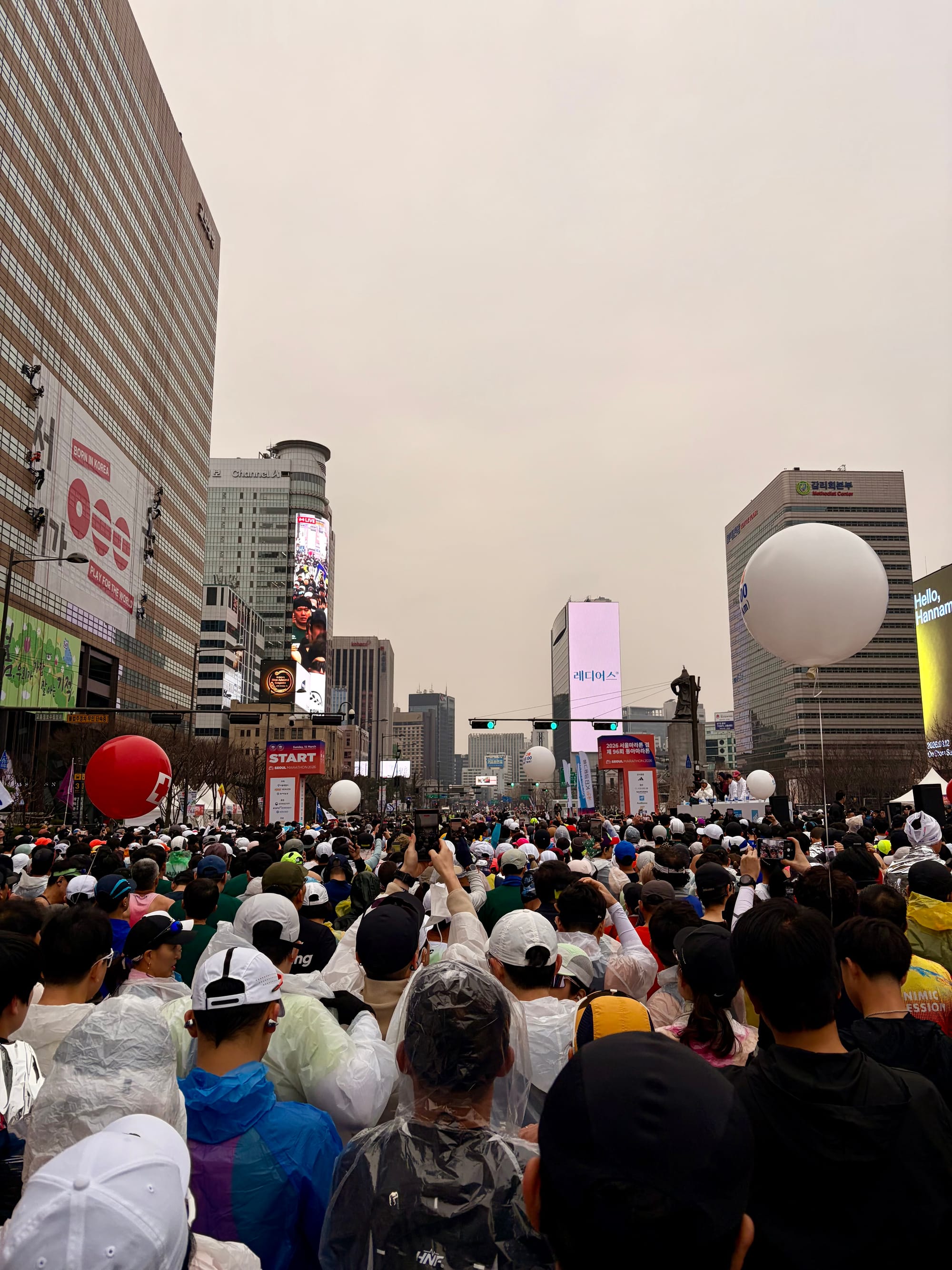
First 2K: all according to plan, keeping the pace around 5:57/km.
3-5K: Starting to get into the rhythm, feeling things out, and getting properly warmed up. Pace somewhat picked up, in the range 5:39-5:52/km. Now, keeping in mind that target average pace for sub-4-hour marathon is 5:41/km. I started thinking This doesn’t feel too hard, maybe I can keep this up. But also Don’t go out too fast too soon.
6-10K: 5:45/km. I’m feeling that the effort is still relatively low. Until this point my heart rate was still in zone 2, only after passing the 10 km marker it creeped up into zone 3.
11-15K: 5:39/km. It’s properly warm now. Or rather — I am warm. The weather is still cold. This is where I said goodbye to the outer layers. Shorts and t-shirt and no gloves from now on.
16-21.1K: 5:40/km. Holding steady. Crossed the half-marathon mark with 2 hours and 46 seconds on the clock. Personal record for an official race. Part of me regretted not going a bit faster. Could have shaved off those 47 seconds somewhere! Oh well.
At this point, I still have hope. Not feeling too fatigued just yet and the finish time prediction on my watch hovers just over 4 hours. Let’s keep going at this pace and reassess later! I tell myself.
21.1-25K: 5:31/km. Actually, crossing the half-way mark gave me an extra push. This is where I felt the best during the entire race. Not too tired and still strong enough to try to push for negative splits. So I picked up the pace.
26-30K: 5:40/km. And went back to the target average pace soon after. That second wind did not last very long. Legs were feeling every step now. I had to lock in. Maintaining this pace and keeping effort in check required full focus. At this point in the race I was looking for every possible edge. I was latching onto other runners to stay in their slipstream and find a bit of a shelter from the headwinds.
31-38K: 5:44/km. I know it’s going to be close. Every stride is difficult. I want to slow down, recover some energy. I feel fatigued. I see my pace slipping slightly. The numbers I see surprise me. How can it feel so much harder to run this much slower!? Finish time prediction dips below 4 hours and then goes back up again. I tell myself: I’ve come this far, trained for so long, kept my pace for this entire distance — can’t give up now!
39-42.2K: 5:22/km. I look at my watch all the time — it gives me 3:59:20 prediction. I speed up. I know I need to have some extra buffer. As we cross the Jamsil Bridge I realize this is the final stretch. I am giving it my all. And I’m surprised again — I actually have some power still left in my legs! Let’s go!
It’s a mad dash to the finish line. It is down to the wire. I really hope that the Race Screen prediction is not screwing me with those numbers.
I see the finish line. I pick up the pace to what, at that moment, feels like a sprint. Last 400 meters I run at 4:40-ish pace. This should not be possible, I remember myself being more tired and slower in the final meters of 10K races.
And then the finish line — crossed! I press the stop button on my watch and I’m happy with what I’m seeing. The official result should not be far off — I think I am allowed to start celebrating already.
Watch time: 3:59:02
Official result: 3:59:33
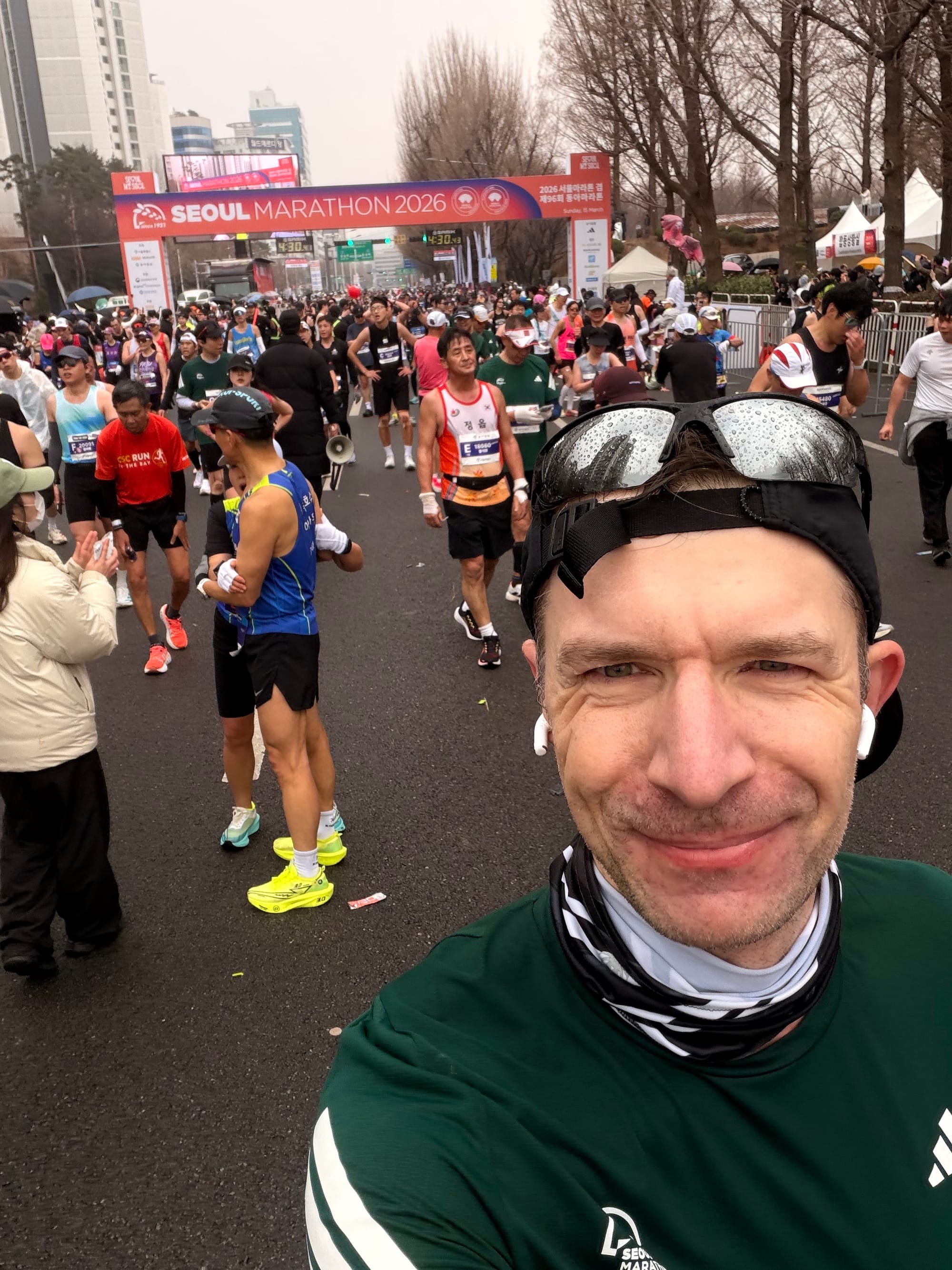
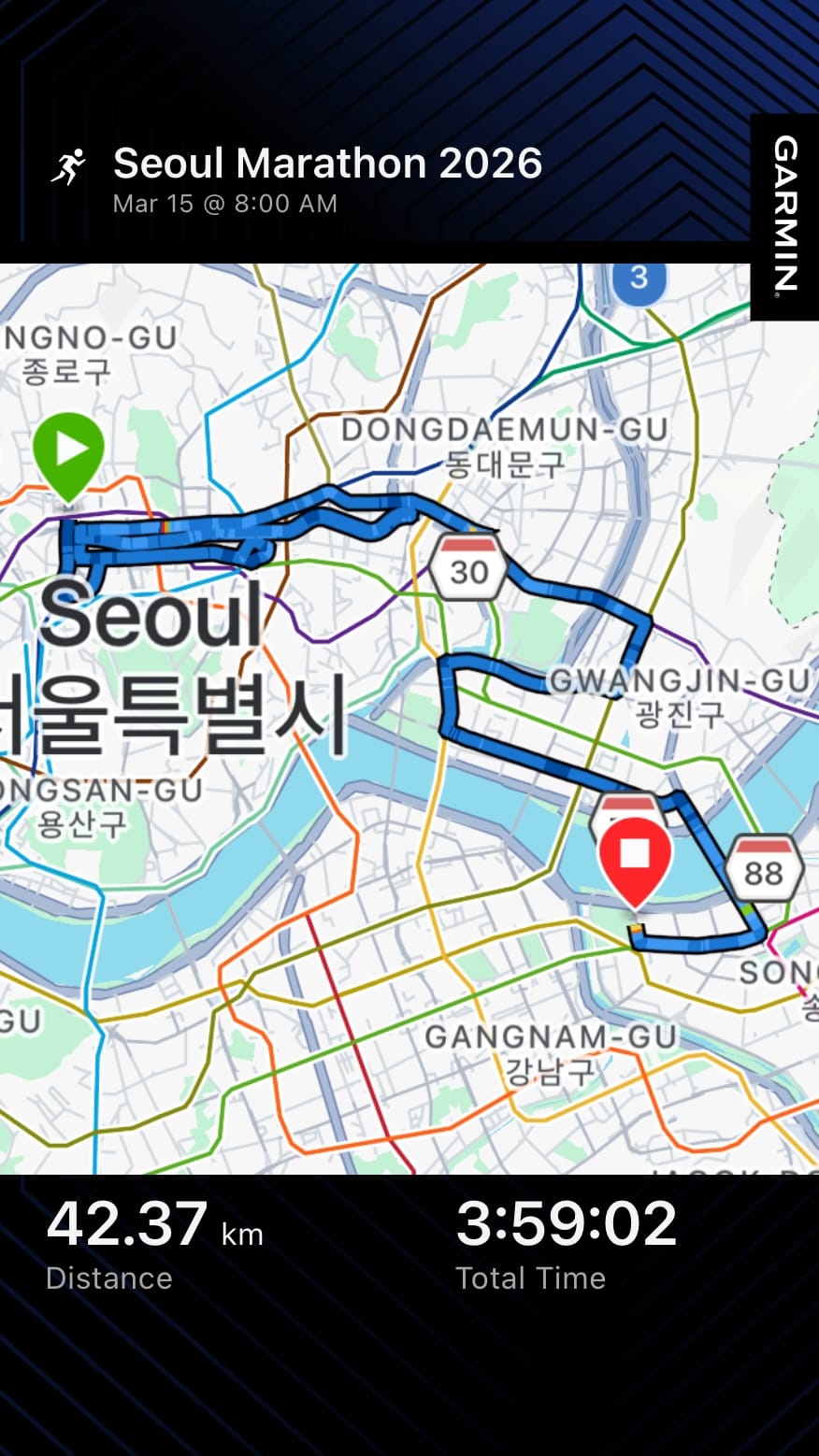
I’m glad I gave myself enough buffer and did not just trust the watch (I suspect I lost those 31 seconds to autopause at some water stations)! And I’m amazed that I found the strength to push in those final four kilometers. That made all the difference.
Keeping the splits mostly consistent throughout the race helped as well, of course! I am quite proud of this mental discipline that kept me on target for the most of the 42 km race. Wasn’t easy!
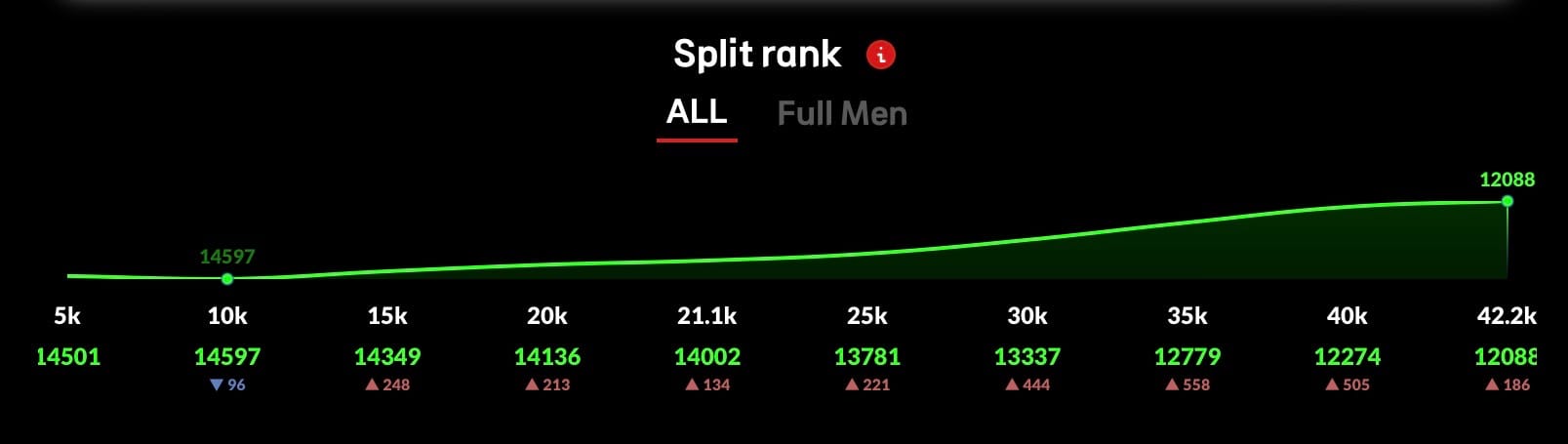
And for the first time ever, I managed to race with negative splits. Second half was 2 minutes faster than the first. Not a huge difference but it’s so encouraging and rewarding to see that my training paid off.
Lastly, it’s fascinating to see, in actual numbers, how real hitting the wall is. While I kept my splits pretty much consistent, other runners were fading after the 25 km mark. I passed almost 1,700 other people in that last 17 km.
All in all, a great race. Could have not asked for a better one. Sub-4 seemed impossible to me (I really thought that my coach was messing with me!) but here we are.
But… now what? Feels strange without any new major race on the calendar…
Member discussion